Service lifecycle
Kranz supports two sources of lifecycle truth.
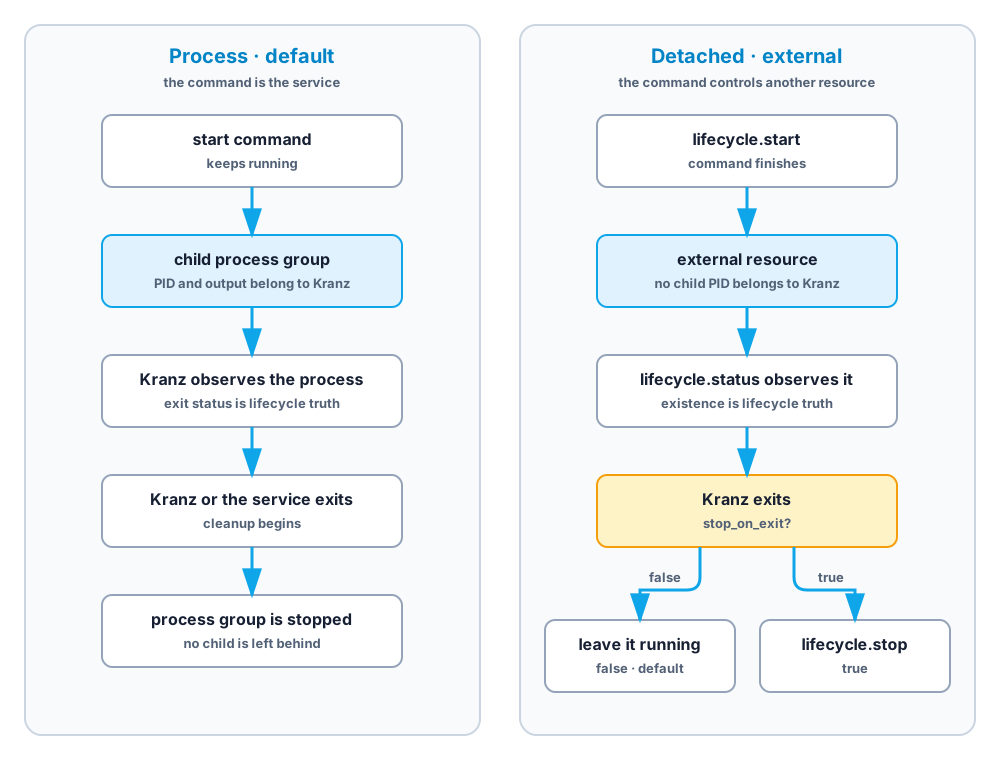
Choose process when the command itself is the service. Choose detached when the command creates or reaches a resource that continues independently.
Process supervision
supervision: process is the default. Kranz owns the command's process group, tracks its PID, captures output, and stops it when Kranz exits.
services:
  api:
    command: npm run dev
command is shorthand for an explicit start definition:
services:
  guarded-worker:
    lifecycle:
      start:
        command: npm run expensive-worker
        confirm: true
confirm controls confirmation before start. Every TUI operation that stops a service asks for confirmation, including stop, restart, and all-service variants.
Detached supervision
Use supervision: detached when the start command finishes before the external resource stops—for example docker compose up -d or an SSH operation.
services:
  remote-stack:
    supervision: detached
    stop_on_exit: false
    detect_ports: false
    lifecycle:
      start:
        command: ssh host 'cd app && docker compose up -d'
        timeout: 2m
      stop:
        command: ssh host 'cd app && docker compose stop api db redis'
        timeout: 2m
      status:
        type: command
        command: ssh host 'cd app && ./stack-status.sh'
        interval: 5s
        stopped_interval: 30s
        timeout: 15s
        failure_threshold: 3
        running_exit_codes: [0]
        stopped_exit_codes: [3]   # opt-in; see below
      logs:
        command: ssh host 'cd app && docker compose logs -f --tail=100'
The status command observes existence, not health.
By default it follows the convention every shell command already follows: exit 0 means the resource is running, and any other exit code means it is stopped. Most probes need nothing more than this:
status:
  type: command
  command: docker compose ps --status running --quiet api | grep -q .
Declare stopped_exit_codes only when your probe can distinguish "not running" from "I could not find out". That opts into a three-way contract:
- an exit code in
running_exit_codesmeansrunning; - an exit code in
stopped_exit_codesmeansstopped; - any other exit code is unclassified, and
failure_thresholdconsecutive unclassified results produceunknown.
A probe that never produced an exit code — it could not start, timed out, or was killed — is always unclassified. Kranz reports unknown rather than claiming a resource is stopped on no evidence.
Status results cannot overwrite an in-flight starting or stopping transition. Stopped and unknown resources are polled on the slower stopped_interval, which defaults to 30s because such a resource only changes when something outside Kranz acts on it. Status observation never invokes a process restart policy.
Optional capabilities
A detached service can omit capabilities it does not own. A service with only lifecycle.status is observe-only: Kranz displays its state, while start and stop remain unavailable.
Detached services default to stop_on_exit: false. Set it to true only when runtime shutdown should execute the external stop command. Detaching a TUI does not invoke it. Declared ports remain valid endpoint documentation, but local PID discovery is unavailable and detect_ports: true is rejected.
See the lifecycle playground for a safe local simulation of managed and observe-only external resources.